Angela D. Coker, Professor
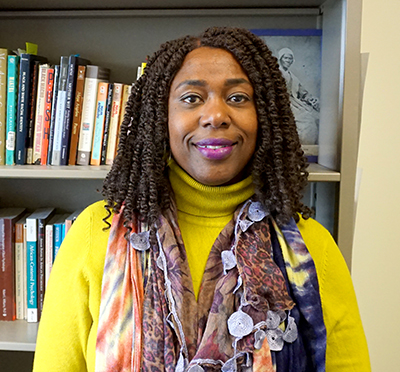 Office: AL 317 | Phone: (619) 594-1025 | Email: [email protected]
Angela Coker, Ph.D., LPCC is a Professor in the Department of Women’s, Gender, and Sexuality Studies at San Diego State University. She is a scholar and counselor whose research is situated at the nexus of Black feminism, clinical practice, and social advocacy. Dr. Coker is Past-President of the Association for Multicultural Counseling and Development, and a longtime active member of the American Counseling Association where she currently serves on its Advisory Council. Her scholarship is fueled by a fundamental feminist question: How do structures of power and privilege shape women’s psychological lives, and what becomes possible when women’s lived experiences are centered as sites of knowledge production, and mental health promotion?
Grounded in intersectional and Black feminist epistemologies, Dr. Coker examines the complex relationships between individual experience and the broader social, cultural, and political structures that organize women’s lives. Her work centers Black women while engaging broader questions of gender, racialization, colorism, identity, embodiment, marginality, leadership, mental health, and human flourishing. Across these areas, she challenges deficit-oriented clinical models about Black women and instead foregrounds agency, resistance, relationality, cultural knowledge, and the often-unrecognized labor through which women sustain themselves, their families, and communities. At the same time, she interrogates the ways Black women cultivate practices of meaning-making, healing, self-definition, and resistance that exceed dominant psychological frameworks.
Dr. Coker’s intellectual orientation is deeply informed by Black feminist traditions that insist upon the inseparability of knowledge, lived experience, and personal wellness. She understands lived experience not merely as anecdotal evidence, but as an important epistemological location from which systems of power can be examined and contested within the context of mental health wellness. Her scholarship therefore attends to the knowledge produced through group therapy, individual counseling, relationships, community engagement, cultural practices, and everyday acts of survival and self-determination.
As an educator, Dr. Coker embraces feminist pedagogy as both an intellectual practice and a form of social intervention. Her classrooms are spaces for critical inquiry in which students are encouraged to interrogate normalized assumptions about gender, race, power, sexuality, culture, and knowledge. She views teaching as an opportunity to cultivate critical consciousness while affirming students as emerging intellectuals capable of questioning inherited narratives and imagining alternative ways of developing social thought. Her scholarship also extends feminist inquiry beyond conventional boundaries. Dr. Coker explores the intersections of Black women’s mental health within the context of personal body image, academic development, mentorship, leadership, and international engagement. Her current work explores the nexus between Black feminism, women’s self-care/wellness, body positivity, and personal development, in addition to emerging scholarship that explore principles and integration of Buddhist practices that may support Black women’s emotional and spiritual growth.
Mentorship and intellectual community are likewise central to her feminist practice. Dr. Coker is particularly attentive to the experiences of Black women and scholars of color navigating institutions in which their intellectual contributions, leadership, and authority may be simultaneously sought and contested. Her mentoring philosophy is grounded in affirmation, mutuality, intellectual generosity, and the creation of spaces in which emerging scholars can develop authoritative voices without surrendering the fullness and complexity of their identities.
Internationally, Dr. Coker has been a Fulbright-Hays scholar who examined cultural diversity and racial identity in Brazil, a visiting scholar at the University of Botswana, the University of the Western Cape in Cape Town, South Africa, and served on numerous graduate committees as an external reviewer at the University of KwaZulu-Natal in Durban, South Africa. She has also provided professional development training for UNICEF staff in Gaborone, Botswana, in addition to community outreach to orphanages in Windhoek, Namibia and Nairobi, Kenya.
- WGSS 101: Gender, Self, Identity, and Society
- WGSS 325: Psychology of Women
- WGSS 336: Women of Color in the US
- WGSS 510: Black Feminist Thought
- WGSS 522: Women, Madness, and Sanity
- WGSS 536: Gender, Race, and Class
- WGSS 585: Feminist Organizations and Activism
Coker, A.D. (in print). Black Women, Self-Care, and Buddhism: The Intersections of race, gender, and spiritual development. In A.E. DeNapoli, S. Gadkar-Wilcox, & K. C. Taylor (Eds.), Women and Representation in Buddhist Asia: Innovative pedagogies, alternatives, and reimagined philosophies. State University of New York (SUNY) Press.
Coker, A. D. & Rothblum, E.D. (2025). Mentoring mid-career women faculty: Expanding roles and changing priorities. Psychology of Women Quarterly, 49(1), 137-142. https://doi.org/10.1177/03616843241266257
Coker, A.D. (2025). The Accidental Academic: A Message to my sisters in higher education. In Corey, G. (Ed). Counseling Journeys: Reflections and Voices from the Field (pp.14-16). Solana Beach, CA: Cognella.
Coker, A.D. (2023). Pretty on the inside: Navigating self-care. In G. Corey, J., Muratori, M., Austin, J. T., & Austin, J. A. (Eds.) Counselor self-care (pp. 113-116). Alexandria, VA: American Counseling Association.
Coker, A.D., Culver, J. & Martin, C. (2023). SisterScholars: A college support group for Black women. Journal for Specialists in Group Work, 48(2), 161-171. https://doi.org/10.1080/01933922.2023.2190776
McCarthy, M.J., Bauman, S., Coker, A., Justice, C., Kraus, K., Luke, M., Rubel, D., & Shaw, L. (2022). ASGW Guiding Principles for Group Work. Journal for Specialists in Group Work, 47(1), 10-21. https://doi.org/10.1080/01933922.2021.1950882
Awad, G. Kashubeck-West, S., Bledman, R. A., Coker, A. D., Stinson, R. D., & Mintz, L.B. (2020). The role of enculturation, racial identity, and body mass index in the prediction of body dissatisfaction in African American women. Journal of Black Psychology, 46(1), 3-28. https://doi.org/10.1177/0095798420904273
Brown, E. & Coker, A. D. (2019) Promoting the resiliency of African American teens experiencing ambiguous loss. Journal for Specialists in Group Work, 44(4), 286-299. https://doi.org/10.1080/01933922.2019.1669751
Coker, A.D., Martin, C., Culver, J., & Johnson, C. (2018). Black women’s academic and leadership development in higher education: An autoethnographic inquiry. REVISTA PERIFERIA,10(2), 44-66. https://doi.org/10.12957/periferia.2018.33714.
Coker, A.D. & Majuta, A. R. (2015). Teaching group counseling in Botswana: Two U.S.-trained counselors discuss experiences and share cultural considerations for practice. Journal for Specialists in Group Work, 40, 102-116. https//doi.org/10.1080/01933922.2014.992506
Kashubeck-West, S., Coker, A. D., Awad, G., Hix, R., Bledman, R. A., & Mintz, L. (2013). Do measures commonly used in body image research perform adequately with African American college women? Cultural Diversity and Ethnic Minority Psychology,19(3), 357-368. https://doi.org/10.1037/a0031905
Mintz, L. B., Awad, G. H., Hix, R., Bledman, R. A., Coker, A. D., Kashubeck-West, S., & Connelly, K. (2013). Weighing and body monitoring among college women: The scale number as an emotional barometer. Journal of College Student Psychotherapy, 27(1), 78-91. https://doi.org/10.1080/87568225.2013.739039
Pope, M., Pangelinan, J., & Coker, A. D. (Eds.). (2011). Experiential activities for teaching multicultural competence in counseling. Alexandria, VA: American Counseling Association.
Coker, A. D. (2011). The voice of the voiceless: An interview with Thelma Daley. Journal of Counseling & Development, 89, 244-249. https://doi.org/10.1002/j.1556-6678.2011.tb00084.x
Coker, A. D., Meyer, D., Smith, R., & Price, A. (2010). Using social justice group work with young mothers who experience homelessness. Journal for Specialists in Group Work, 35, 220-229. https://doi.org/10.1080/01933922.2010.492901
Enriquez, M., Cheng, A., Kelly, P. J., Witt, J., Coker, A. D., & Kashubeck-West, S. (2010). Development and feasibility of an HIV and IPV prevention intervention among low-income mothers receiving services in a Missouri childcare center. Violence Against Women,16, 560-578. https://doi.org/10.1177/1077801210366869
Huang, H. & Coker, A. D. (2010). Examining issues affecting African American participation in research studies. Journal of Black Studies, 40, 619-636. https://doi.org/10.1177/0021934708317749
Coker, A. D., Huang, H. & Kashubeck-West, S. (2009). Research with African Americans: lessons learned about recruiting African American women. Journal of Multicultural Counseling and Development, 37, 153-165. https://doi.org/10.1002/j.2161-1912.2009.tb00099.x
Durodoye, B. A. & Coker, A. D. (2008). Crossing cultures in marriage: Implications for counseling African American/African couples. International Journal for the Advancement of Counselling, 30, 25-37. https://doi.org/10.1007/s10447-007-9042-9
Coker, A.D. (2006). In big mama’s house: Intergenerational issues. In S. M. Hobson & L. A. Carlson (Eds.), Critical incidents in counseling children (pp.147-149). Alexandria, VA: American Counseling Association.
Bryant, R. M., Coker, A. D., Durodoye, B.A., McCollum, V. J., Constantine, M.G., Pack-Brown, S., & O’ Bryant, B. J. (2005). Having our say: African American women, diversity, and counseling. Journal of Counseling & Development, 83, 313-319. https://doi.org/10.1037/1931-3918.2.1.10
Coker, A. D. (2004). Counseling African American women: Issues, challenges and intervention strategies. In G.R. Walz, & R. Yep (Eds.), VISTAS: Perspectives on Counseling 2004 (pp. 129-136). Alexandria, VA: American Counseling Association and Counseling Outfitters/CAPS Press.
Coker, A. D. (2003). African American female adult learners. Journal of Black Studies, 33, 654-674. https://doi.org/10.1177/0021934703033005007
National Endowment for the Humanities (NEH) (2023). Professional Development Grant. Women and Buddhism: Religion, Politics, and the Arts. Summer Institute. Honolulu, Hawaii.
Bill and Melinda Gates Education Foundation (2017). Black Women’s Academic and Leadership Development in Higher Education.
J. William Fulbright Foreign Scholarship Board & U.S. (2011). Department of Education - Fulbright-Hays Seminars Abroad Program (Brazil).
Robert Wood Johnson Foundation (2008). New Connections Research Training Program Grant. San Diego, CA.